“Super Santos”, Saviano’s Calcio and Camorra Film
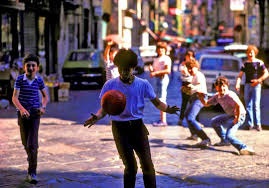
TORONTO – Watching Serie A this season has me wondering what – if anything – distinguishes the Associazione Italiana Arbitri from Minnesota’s infamous “Learning Center”. From phantom fouls to MIA VAR officials, the stench of scandal has unfortunately invoked the memory of Serie A’s calciopoli past. Coincidentally, it’s the perfect climate to preview Roberto Saviano’s upcoming film Super Santos, a story about the urban anthropology of street soccer in Italy.
At the heart of the story, however, is an exploration of how the Camorra corrupts childhood innocence. Saviano (in the pic below), a renowned Italian Journalist, wrote the short story “Super Santos, Posts and Station Masters” in 2011 as a special publication attached to the Corriere Della Sera. It featured four fictional boys who mirrored his own life while growing up playing soccer in Casal di Principe (Naples).
And much like the coyote’s interspecific cooperation with the badger, the Camorra recruited and groomed young street boys to help assert their control over Neapolitan territories. While a rite of passage for many young boys, playing street ball would inadvertently lead them into back alleys frequented by the brigands of the Camorra gang.
The soccer references were of course metaphors for the criminal operations of the gangs. Young boys were enlisted as “Posts” (goal posts) and “Station Masters” (goalkeepers) – an allusion to the more sinister tasks of being “lookouts” and “station directors” for drug dealing.
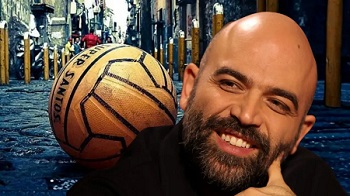
And the title Super Santos refers to one of the most popular soccer balls ever produced, a ball that most southern Italians, especially, grew up owning or playing with. It was created in 1962 by Stefano Seno, an employee at Mondo in Alba. Inspired by Brazil’s 1962 World Cup victory, he designed a ball to capture the golden age of Brazilian soccer.
The ball’s popularity continues today as the Mondo Group produces 450,000 balls per day and sells roughly 15 million units per year. The ball’s bright orange design was a supposed homage to the “vibrancy” of Brazil’s “Beautiful Game”, with the colour orange being linked to energy, creativity and success. And “Santos” was of course the name of Pele’s club.
Perhaps Saviano realized that the bittersweet nature of living in Naples was best described through the world of soccer: How something that induces such ecstasy could be so corrupted. Or maybe he’s saying that the unfortunate bond between the mob and calcio is indissoluble – forged at a very early age (in Naples at least).
Whatever the case, Saviano has dedicated much of his career to shedding light on the modus operandi of the Napoli-based crime syndicate, despite receiving ominous threats and attempts on his life – after the success of his breakout book “Gomorrah” in 2006. And twenty years later with Super Santos on its way into theatres, it’s abundantly clear that Saviano isn’t deterred by threats.
Image of boys playing soccer courtesy of Mundial Style Vintage Football

Massimo Volpe is a filmmaker and freelance writer from Toronto: he writes reviews of Italian films/content on Netflix