
Faraway war, high prices close by

TORONTO – Wars affect all of us. Intuitively, as human beings we all know that the consequences cannot be “good for everyone”, especially if we abandon all controls. Even in “animal culls” or “market monopolies” there are rhymes and reasons underlying eventual “next steps”.
As in those cases, we precede wars with public relations campaigns best described as demonization campaigns directed to tarnish our targets, but, unless one is taken by complete surprise, there are no “good guys”. That makes it all the more difficult to restore balance and civility when the fighting ends.
At the Corriere Canadese, we tried to make sense of tactics and strategies; our editorial staff is fairly educated boasting the presence of four writers each with at least one Masters’ degree and a corps of freelancers with equal qualification and expertise from Italy and the Mediterranean Basin. We come back to how we are implicated in current wars.
Vladimir Zelensky repeatedly says Ukraine is fighting a proxy war against an Imperialist power for our democratic values. Benjamin Netanyahu is equally insistent that his and Donald Trump’s actions are driven by a desire to rid the world of terrorism.
If the reader will permit a [brief] deviation from the moralistic justification and anti- military industrial complex that dominates internationally (the top eleven countries, in terms of Defense budgets, expend approximately $2.3 trillion annually to prepare for war), there are transportation and energy considerations that outweigh humanitarian concerns – unfortunately (see the map below, courtesy of Visual Capitalist).
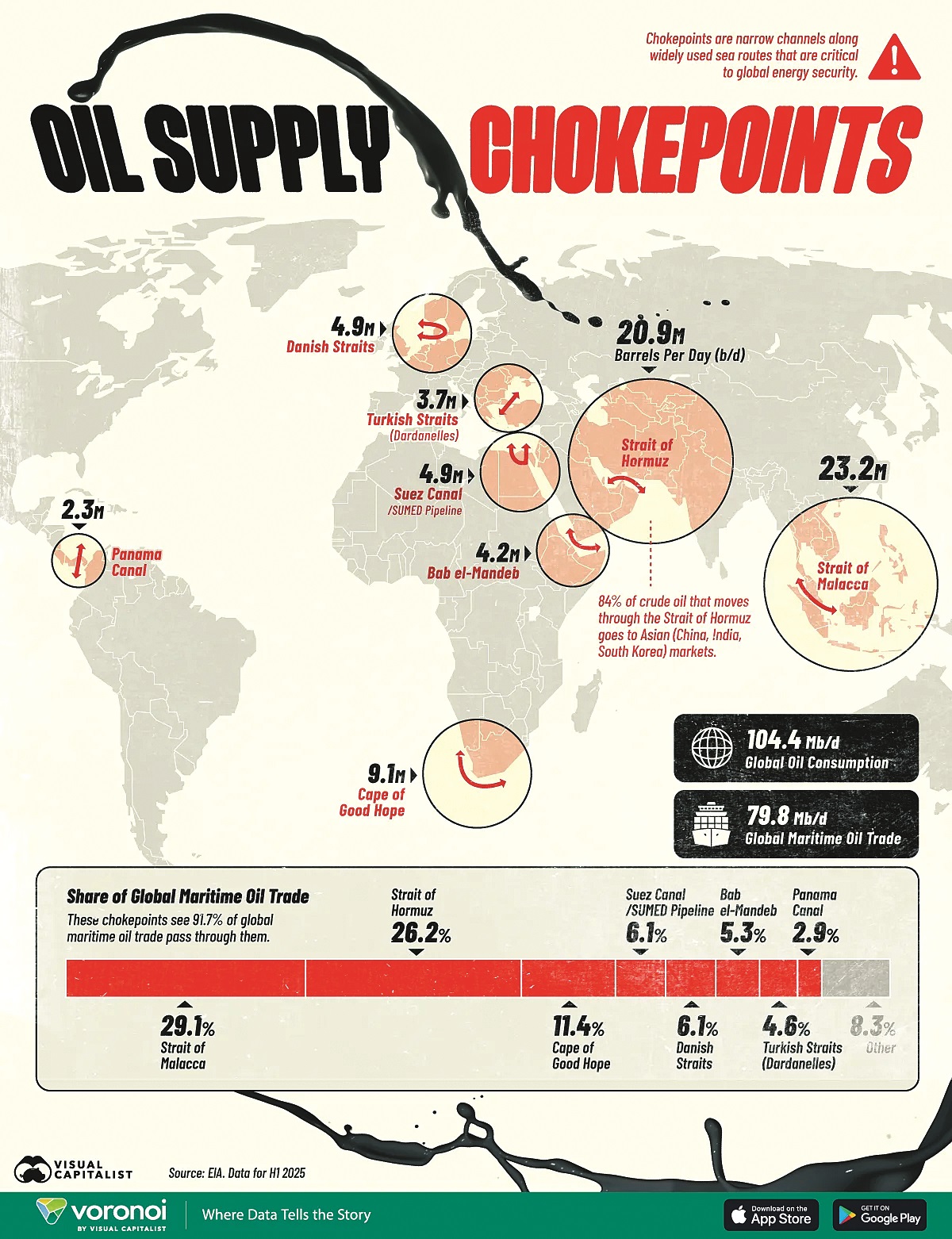
Last week, ending March 6, the price of oil (Brent Crude) jumped by 34.97% to reach $91 USD (equal to approximately $123.76 Canadian). The world consumes 104.4 million barrels of oil per day – every day – more than three billion per month. As the war escalates, so will the price.
Have a little fun: take out your calculator and determine how many trillions that is per year. And, keep in mind, – only 80% of that consumption is reliant on maritime transport to reach end users (refineries and distribution centers). The war is taking place eight thousand kms away.
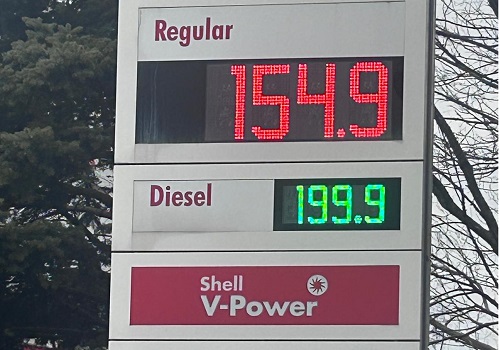
Yesterday, local gas prices near the Corriere jumped to $1.54 per litre (see the pic above) from $1.19, ten days ago. Canada’s crude oil known reserves are among the top our in the world. Our infrastructure to deliver that crude to market is … let us continue to be civil. According to Canadian experts interviewed by national media outlets, if a gap in supply emerges, Canada may be able to fill about 250,000 (1/4 of 1%) three months from now.
We know why.