Heady Times or returning to a pre-industrial past?

TORONTO – I enjoy a celebration as much as the next person: good food, good company and good music. “Fife and drums” are not a part of that equation – but they are an integral element of a jingoistic, protectionist definition of sovereignty. It the variety that is all the rage.
Such “self-promotions” historically have been associated expansionism, militarism and political domination – colonialism is but a moderate expression of the same thing. In my lifetime, several “nation-defining” initiatives and attendant legislatives adaptations made to effect them have in my humble opinion changed the character of what we call “Canada, our home and native land”.
In many respects, our country was the “vision” that emerged from the competition among some political entities for what was a relatively lucrative fur trade in the northern part of North America, involving Aboriginal “communities” and European – mainly, though not exclusively, English and French. As that trade morphed into lumber, mining, fishing, other related industries made the land more appealing, but the altered “vision” required a political – domestic and international – adjustment. Sound familiar?
The history is fascinating for several reasons, including the role of the ancestors of many of our readers (that too is for another set of articles). It is steeped in the theme of survival and sovereignty – for the European Canadians – approximately two hundred years ago, following the war of 1812-1814 between the newly formed USA and the territories under British rule (primarily strips of land along the Lake Ontario- St Lawrence River waterway.
On-going skirmishes between them and the ever-present threat of absorption into the new republic to the South – especially after the American Civil War – was the primary impetus for Confederation. They motivated politically driven infrastructure programs like building a transcontinental railroad to connect Vancouver to Halifax (5,800 kms), an immigration program to populate the vast territory and the construction of port facilities to facilitate trade East-West and a Preferential Tariff program to “push” commerce to Europe through Britain.
The vision worked for decades (though not without hiccups), promoting and sustaining a strong manufacturing sector until the base for that was eroded by the Canada-USA Free Trade Agreement (1989), the follow-up North America Free Trade Agreement (NAFTA) in 1993 with the addition of Mexico. The net result of all that was the gradual movement of commercial exchange (trade) direction from an East-West direction to a North- South one.
The bulwark of that metamorphosis saw the end of the Subsidies associated with the Crow’s Nest Pass Agreement, the Wheat Board and associated investments to solidify developments of waterways like the Welland Canal, the St. Lawrence Seaway and improvements to ports such as Montreal, St. John’s and Halifax.
Investments (heavily subsidized by the federal government) in steel foundries and aluminium mills were de riguer.
It all worked until the Americans woke up one day and said, “wait a minute, this is all competing with our own industrial capacity and they are underselling our own producers”. Time for MAGA.
Time to reverse that east-west trend, says their spokesman, Donald Trump. Who speaks for sovereignty issues?
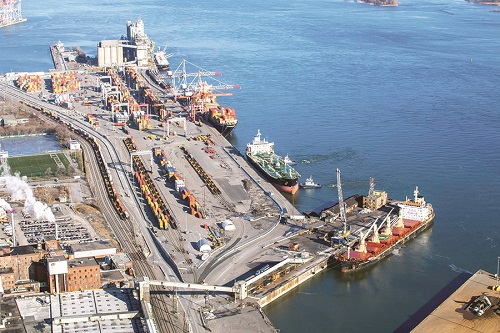
In the pics below, the Port of Montreal (photo: Port-Montreal.com) and the Port of Halifax (photo: Wikipedia)