Cannes Shuts Out Italy
![Gold sculpture featuring the Palm d'Or emblem and the words 'Festival de Cannes' on a pink-carpeted platform at the Cannes Film Festival.]](https://www.corriere.ca/wp-content/uploads/2026/05/film2-5.jpg)
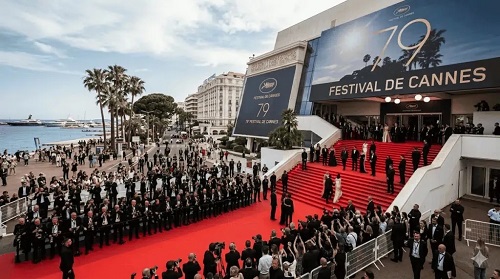
TORONTO – This year’s theme of Italy missing out continues with the country’s latest absence from the Cannes Film Festival lineup. The 79th edition of France’s major festival marks the first time in 10 years that no Italian films have been selected in the feature film category. And Italy’s cousins from across the Alps have wasted no time pouring salt in the wound.
When taking questions about Italy’s lack of representation, the Festival’s Chief Artistic Director Thierry Frémaux engaged in a bit of negging, quipping about their World Cup failure: “I share your sorrow at not seeing Italy at the World Cup, but I remind you that we (France) were not there in 1962, 1966, 1970, and 1974”.
While the French have certainly mastered the art of the backhanded compliment, they are also a people who loathe over-the-top praise – something some filmmakers feel entitled to. “Italy is a great country of cinema, but let’s say that perhaps we haven’t seen films that deserved to be in competition. It’s not a big deal. It can happen, and the films will return”, added Frémaux.
The Italian reaction was summed up by Il Sole 24 Ore: “Not to be the usual provincial, but the absence of Italian cinema at the 79th edition of the Cannes Film Festival is worrying. Uncertainty about tax credit and tax deductions have produced the feared result: Italian cinema is at a standstill”.
It’s key to note that 2,541 total feature films were submitted to Cannes from all over the world, 21 of which were selected. These films are measured against an elite yardstick. And the defeatist response is uncharacteristically Italian. Italians have always had a penchant for melodrama, but not defeatism. They mastered opera, Baroque art and cinema using melodrama, turning heightened human emotion into visual theatre. What they didn’t do was wallow over state funding.
A young, broke Michelangelo famously buried his “Sleeping Cupid” statue in the dirt to fake an archeological discoloration. He knew wealthy Cardinals would pay fortunes for Roman artifacts. When his buyer discovered the fraud, he was so impressed by the work, he paid Michelangelo 150 gold ducats (roughly $85,000 USD today) for his next commission – a statue of Bacchus. That work led to his famous “Pietà”.
Da Vinci sketched flying machines for free. But they were used as a larger creative strategy to fund his lifestyle. His intention was to convince the Duke of Milan, Ludovico Sforza, to hire him for his court, as an artist and military engineer. He was successfully appointed to Sforza’s court for 17 years, and was paid 2,000 ducats a year (ca. $1M USD/y).
“The impediment to action advances action. What stands in the way becomes the way”, wrote Marcus Aurelius. To him, failure was a call to action, resilience and adaptability. Seneca argued, “No man is more unhappy than he who never faces adversity. For he is not permitted to prove himself”. The time for whining is over.
Image of Cannes Entrance courtesy of Paris ZigZag

Massimo Volpe is a filmmaker and freelance writer from Toronto: he writes reviews of Italian films/content on Netflix