Lubinski calls to reinstate the International Language Day Program

TORONTO – Trustee Teresa Lubinski Fights Back: In a letter addressed to Senior Staff at the Toronto Catholic District School Board (TCDSB), dated June 26 and obtained by the Corriere over the Canada Day weekend, she calls on them to – demands that – they reinstate the International Language Day Program and provide transparency of decision-making that led to their elimination (the letter is here: REINSTATE I.L. DAY PROGRAM).
Her anger virtually seethes through the written word and the sarcasm barely hides her disappointment at the Boards dismissive attitude of her parents and community in announcing that their faith in the Catholic schools on character and identity through language study must come to a close at the end of September.
“For fifty years, the International Languages (IL) Day Program has been a part of TCDSB. […] For five decades, the TCDSB found funding because it recognized that heritage language education is not a luxury, it is identity, culture, [reflecting] faith and belonging.”
Then, just before the end of Academic 2025-26, a Catholic board with an operational budget of approximately $1.3 billion, abruptly ends a program costing circa $6 million to save money – a saving of less than one half of one percent, 0.46% for framing purposes.
When contacted by the Corriere, she pointed to the Constitutional rationale for English Separate [Catholic] Schools in Ontario. No government would attempt this in a French or aboriginal language environment. Yet it is acceptable to deprive Ukrainian, Italian, Portuguese, Mandarin, Polish and Philippino children of similar rights. Remember, she added, the TCDSB’s annual operation, is funded by taxes levied on property and businesses whose owners are identifiable and registered as Catholic.
Who speaks for them, she asked rhetorically? “At a minimum, parents and the community deserve a transparent, itemized breakdown of the International Languages Day Program’s costs, including both financial expenditures and staffing resources”, within that $1.3 billion operating budget.
Who proposed the discontinuance, she asked. What informed the debate that led to the ending of the program in the 39 schools where it was still being offered. As if to drive home the point, she repeated the question expressed in her letter: did this process begin before the Ministry of Education assumed supervision of the Board?
Or, as it seems ever more likely, the Supervisor relied on the same fault-ridden advice that informed the trustees before he came along? For her part, Trustee Lubinski prepared and hand-delivered about 1,000 petitions, in her ward, demanding meaningful consultation, transparency, and a clear understanding of the rationale behind the decision – plus a re-instatement of the program. Other trustees apparently have done the same. It is as the expression goes… a developing can of worms.
Meanwhile, the CUPE local representing the International Languages instructors has begun legal proceedings to protect the interests of their members. The Corriere reached out to the CUPE local president, as well as the CEO, for comment but as at going to print had not received a response.
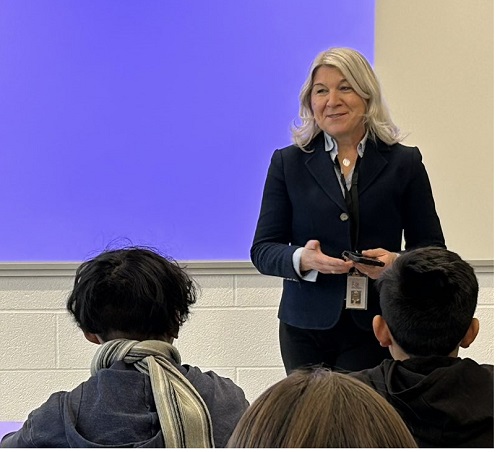
In the pic below, Teresa Lubinski in the classroom at a Toronto Catholic District School Board school (photo: Twitter X – @LubinskiTeresa)