
“I want to serve”: Christopher Mammoliti’s challenge to revitalize the TDSB

TORONTO – “I want to serve”.
It does not take long to recognize someone with clarity of thought. It takes even less to understand there is a structure on which that clarity is based and a vision that drives the individual forward. It is a bonus when someone with those qualities benefits from experience and the sense of civic responsibility to put acquired “talents” to public use. We are in the final three weeks of time available to potential candidates for public office in municipalities to declare and register their intent to serve.
Christopher Mammoliti, family man, former Vice-Chair of the Toronto District School Board, Cancer survivor and experienced businessperson has put his name forward as a candidate for election to a School Board whose recent reputation embodies the most negative perceptions of public education. It used to be the opposite. What follows is a synthesis of a wide-ranging conversation about the politics behind educational planning.
Chris, the Minister of Education just “blew up” the Toronto District School Board of trustees (TDSB), allegedly for financial incompetence and for scant knowledge and practice of good governance principles. He cut the number of trustees in half and fired its CEO. Are you sure you want to be a trustee again?
More than ever! We owe it to our children and to our seniors to refocus. The TDSB is a multi-billion-dollar operation ($3.2 billion last year), with about 235,000 students, 42,000 staff (teaching and non), 579 schools and a Real Estate arm with assets valued at $20 billion. As a Board, it has had proven unable to meet educational standards expected of a modern, forward-looking urban institution. I could recite a litany of faults begging for attention, but it is important to understand that the Ministry of Education started to do the same and has said “that’s enough”!
From my perspective, our first goal is to re-establish ourselves as a legitimate partner of the province in public education, as a capable representative of the community’s and parents’ needs. We could disappear overnight if the Minister has a mind to do it. Unlike the Catholic Boards, we have no denominational, constitutional rights to fall back on. Besides, as you say, we used to be known for practical educational-goal setting and delivery systems prized by the marketplace.
On the premise that you are leading to a second goal underscoring your candidacy, what/how do you want to accomplish by restoring the relationship with the Ministry?
Unlike Catholic boards we have virtually no autonomy. We do have assets and infrastructure – and significant underutilized capacity. If we are to rebuild our relationship with our “biggest funder” – the ratepayers and, on their behalf, the Provincial government – we must make more efficient and effective use of those assets. That includes better management of human resources, targeted programs within a ministry curriculum, supportable adjustments to that curriculum – for example an integrated international languages program and supervision of unionized staff, both teaching and non in a demographic (already circa 55% non-Anglo non-Francophone) where the fertility rate is dropping like an anvil. Our decisions cannot be driven by ideology alone.
In that vein, what proposals do you plan to promote, assuming the minister accepts your advances of co-operation and your fiscal plans for human resources and prudent expenditures?
We need to come to grips with some fundamentals that did not exist when my grandparents and parents built the system for an early post-war manufacturing and construction-based society. The bulk of the first has essentially moved out of the city; the second has become extremely costly. Other levels of government spend hundred of millions per year to build the required skills development and training infrastructure (which we already have in our schools) to then engage instructors from the industry to do what we used to do and what we can do to deliver in locations around the city using those same instructors available through the trades.
Secondly, given the aging population and the increasing incidence of vulnerability to health-related conditions, we can and should prepare willing students for employment needs in those sectors. My own experience makes me especially sensitive to those requirements. Finally, the growth of our hi-tech and financial services sectors demand we train our children for that reality before our foreign competitors “eat our lunch”.
Thank you.
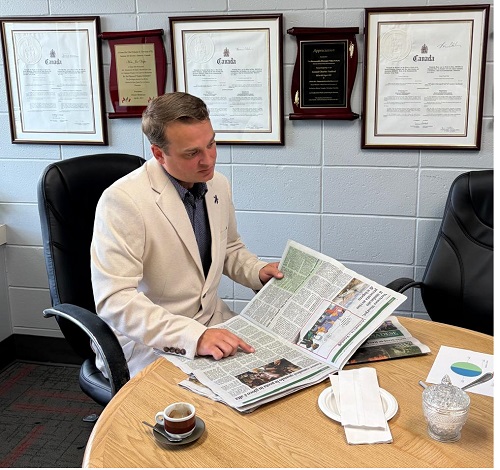
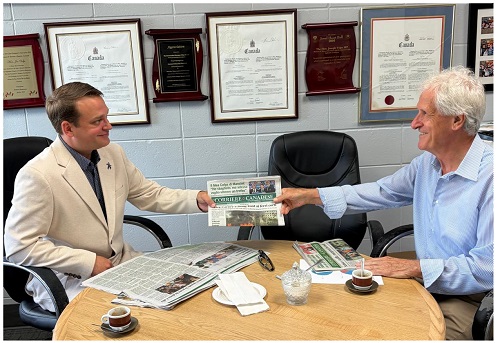
In the pics above, Christopher Mammoliti in the editorial office of Corriere Canadese with the Publisher, Honourable Joe Volpe, and with a copy of the newspaper
More Articles by the Same Author:
- Education: the difference between a clap and a slap
- Istruzione: la differenza tra applauso e schiaffo
- A Catholic culture on the ropes. Who are legitimate candidates in the race for education trustee?
- Una cultura cattolica alle corde: chi sono i candidati legittimi nella corsa per il ruolo di trustee?
- Unadorned Concept of Civic Duty: aim to serve