An economic plan with necessary deficit
TORONTO – When the federal government, under Prime Minister Mark Carney, announced its first budget with a deficit forecast of $78 billion, 50% larger than the previous forecast, the Honourable Joe Volpe asked for my views. He knows my disdain for perpetual government deficits having spent a career in managing investments for pension and sovereign wealth funds. To his surprise I told him I was in favour of the direction the government was taking, and the day-to-day news flow is only reinforcing my view.
I have always believed that government debt should be thought of no differently than personal debt. Some levels are manageable, but ongoing deficits that add to your debt totals and increase at a rate faster than your income growth will result in much higher interest rates demanded by lenders and potential denial of future loans. For any country, the consequences are fatal if lenders believe debt levels have reached untenable levels as this can lead to a declining currency, higher inflation and a lower standard of living.
What makes me reluctantly in favour of the current deficit is that our complacency as a country has allowed for the United States to become 75% of our exports and at a minimum 25% of our GDP. It is easy to understand how we find ourselves so dependent on the U.S. given its geographic proximity and open economy. However, the US is now struggling to satisfy its own longer-term need for raw materials, energy and water, all of which we have in abundance. It is a problem that will extend beyond President Trump’s term. In the past we may have expected a negotiated solution but today the U.S. is demonstrating that it is willing to inflict economic pain and even encroachments on sovereignty to achieve their goals and needs. The threats to Canada are real and present today, politics can accelerate or slow actions, but they will not go away.
Canada must look inward and outward to protect itself and Prime Minister Carney’s approach of reducing provincial barriers and diversifying our trading markets is the correct one. It will take many years and a significant spending on infrastructure if we want our children and grandchildren to experience all the same benefits that we have reaped in Canada. We must act now and maintain a steady pace of progress. Long-term capital investors can be patient, but they do require a continued visibility of return.
The ‘elbows up’ campaign was a strong demonstration by Canadians of their solidarity. But we can already see the difficulty that lies ahead as some early government initiatives are facing roadblocks. We will all be forced to make some sacrifices to succeed and while dialogue is important so is time, we cannot excessively delay decisions or agreements.
Canada’s current debt to GDP ratio places us in the middle of pack versus other major economies. However, to ease the pressure on our government balance sheets we should also tap our unique $6 trillion of pension assets. When I first started my investment career, pension funds were allowed to invest only10% of their assets outside of Canada, a program I was told that was based not just on economics but social policy as well. The industry argued that returns were being limited at a time of significantly underfunded pension plans. The federal government eventually relented and allowed for a gradual increase in foreign investments over multiple years and we now find most pension funds at or near being fully funded with the largest portion of their assets invested outside of Canda. Socio-economic policy should now dictate a reversal and a forcing of pension funds to invest more in Canada. Similarly, corporations with significant earnings and asset bases in Canada need to put more money back into Canada.
During the covid pandemic I was speaking with one of my older and wisest clients who had spent a career advising governments. When I was lamenting the government deficits being incurred globally, he dismissed me outright. He said, “in times of war any price must be paid, and this is like a war that we cannot afford to lose.” I believe the necessary easing of Canada’s dependance on the U.S. has similarities.
Len Racioppo
Coerente Capital
Management Inc.
Leonard Racioppo, CFA, MBA, is a Founding Partner at Coerente Capital Management, responsible for equity analysis and portfolio management for private wealth and foundation clients. He has over 40 years of experience in the financial industry. Previously, he spent 25 years at Jarislowsky Fraser Limited, serving in senior leadership roles for the last 15 years, including President, Director, and Chair of the Investment Strategy Committee.
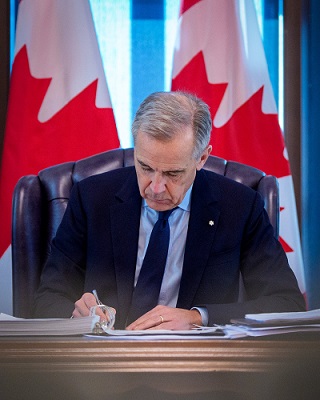
In the pic above, Prime Minister Mark Carney (photo from Twitter X – @MarkJCarney)