Leone’s Spaghetti Western Up for Auction
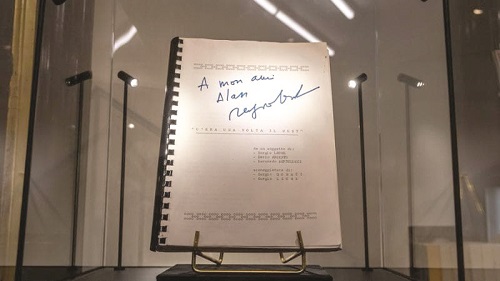
TORONTO – While the modern film industry races toward digital archives and paperless sets, a battered, 420-page stack of typewritten paper is about to command tens of thousands of euros in Paris. Later this month, French auction house Aguttes will put an original, extended Italian screenplay for Sergio Leone’s 1968 spaghetti Western masterpiece Once Upon a Time in the West (C’era una volta il West) up for sale.
With an estimate of €20,000 to €30,000, the manuscript is far more than a piece of vintage cinema memorabilia – it is a surviving cultural artifact that proves a physical script can still carry immense artistic and humanitarian weight.
Before digital files made deleting scenes a matter of a single keystroke, screenplays existed as living, tangible blueprints. Even though Leone’s finished epic runs nearly three hours, this vintage typescript stretches to an astonishing 420 pages, roughly double the length of a standard feature script.
Written in Italian by Leone and co-screenwriter Sergio Donati, the manuscript reads like a novel, packed with deleted sequences, psychological character notes, and visual cues so vivid that composer Ennio Morricone famously used the text to write his iconic score before a single frame of film was shot.
Beyond its sheer length, the document captures a famous creative collaboration in Italian cinema history. Before Donati sat at his typewriter to hammer out these pages, Leone locked himself in a room with two then-unknown young filmmakers – Bernardo Bertolucci and horror master Dario Argento – to watch classic American Westerns and build the story from scratch.
In an era that has steadily dismantled physical libraries and studio vaults in favor of invisible servers, this spiral-bound screenplay remains a rare physical bridge connecting four titans of Italian filmmaking.
Even the manuscript’s journey to the auction block feels like a scene out of a classic movie. Rather than emerging from a corporate archive, the script sat for decades in Donati’s personal collection until the spring of 2006, when French composer and filmmaker Alan Simon visited the screenwriter at his home near Rome.
Recognizing Simon’s lifelong devotion to Leone’s work, Donati quietly stepped out of the room, returned with his personal 420-page copy, and signed the opening page in blue marker: “To my friend Alan.” Even Aguttes specialist Arthur Perrault admitted he nearly fell out of his chair when the artifact surfaced.
Twenty years after receiving that gift, Simon is parting with his most prized possession for a purpose that reaches far beyond cinephile nostalgia: all proceeds from the sale will fund the construction of an earthquake-resistant school in Nepal.
It is a fitting second act for a piece of cinema history. Long after its pages helped shape one of the greatest films ever made, Leone’s hard-copy blueprint is proving that ink and paper still hold the power to build something lasting.
Image courtesy of Aguttes

Massimo Volpe is a filmmaker and freelance writer from Toronto: he writes reviews of Italian films/content on Netflix