The Italian Micro-Budget Advantage
TORONTO – Independent filmmakers Cecilia Miniucchi and Katherine Schimmel have demonstrated a unique cheat code in their short film, Dinner with Dante. Their project acts as a masterclass in cinematic efficiency, proving that an Italian setting does not merely frame a story, but actively provides it. The short film has already captured international attention, winning Best Short Film at the Kinéo Awards during the Venice International Film Festival.
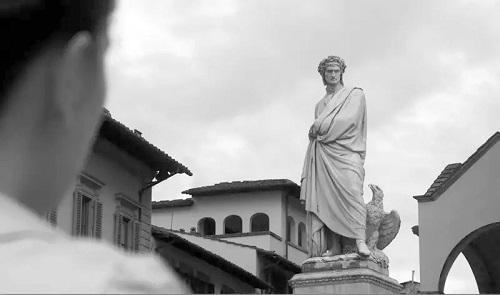
The movie follows a traumatized woman who stands in a Florence square (Piazza di Santa Croce) after World War II and silently talks to a statue of Dante. By using this real historical monument as a backdrop, the directors saved money while creating a powerful setting.
Director Cecilia Miniucchi explained her core vision for this narrative device, stating: “With ’Dinner with Dante’ I wanted to tell the story of an innocent young woman who sees her fiancé explode before her eyes and remains trapped in that trauma, fixed in time like the statue of Dante to which, in her mind, she continues to turn while life passes inexorably“.
Sculpted by Enrico Pazzi, the white marble statue was unveiled on May 14, 1865, to commemorate the 600th anniversary of Dante’s birth. It was erected as a grand gesture of public atonement by the city of Florence, which had famously exiled the poet under threat of being burned at the stake in 1302.
This effortless production value highlights a massive institutional advantage that filmmakers working in Italy may frequently take for granted. For an independent creator, Italy’s historic streets serve as a significant financial equalizer.
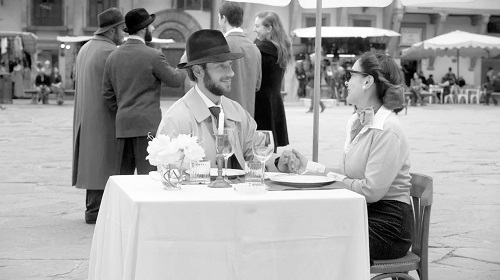
The film’s modest $17,000 budget would surely evaporate before the first camera roll in a modern North American hub like Toronto. Not to mention, finding a public outdoor square in Toronto that features a centuries-old monument framed by matching period architecture is a near-impossible task.
It is precisely this geographical contrast that likely motivated the creators of Dinner with Dante to cross the Atlantic. Having spent the majority of their professional lives navigating the high-cost American film and academic landscapes, both filmmakers understood the immense resources at their disposal in Tuscany.
What would require tens of thousands of dollars in studio set construction in Los Angeles or Toronto is simply a free, public view in Florence. This deliberate focus on local heritage aligns closely with the Meloni administration’s culture ministry reforms, which heavily prioritize funding projects that emphasize telling Italy’s distinct stories and promoting national identity.
Yet, as Dinner with Dante proves, leaning into this structural mandate does not require a one-sided political stance. An artist can deeply love the culture while using its historical backdrops to openly comment on both Italy’s vices and its virtues.
Miniucchi summarized the overarching human message behind this stylistic choice at the festival, noting: “I hate every form of violence, and therefore every war, the sensation and the suffering they leave behind. Above all, this film is a message of peace and a tribute to the innocent victims of every conflict“.
Images courtesy of Jan Bezouska / Dinner with Dante
Massimo Volpe is a filmmaker and freelance writer from Toronto: he writes reviews of Italian films/content on Netflix