A balance between sarcasm and truth in education

TORONTO – It has become a truism that Ontario’s Education System is sick. Reading and writing scores are so discouraging that some boards have started to move away from the Fraser Institute “comparison model” for testing results across the province. EQAO, Ontario’s testing model applied for Primary, Junior and Intermediate students seem mere photo snapshots measuring where students are in the learning process.
The initial concept was that teachers and curriculum designers might make the adaptations after every testing exercise. No such luck. judging by their reading and mathematical skills assessed at the end of each cycle, on average, student scores did not improve appreciably. Due in part to the growth of student registration in private schools where the best that parents can expect is a tax benefit for contributions under Charitable Donations Federally, if their schools are registered and qualified.
Despite the Billions of dollars in public education (depending on the day and nature of the press release from the Ministry, the overall totals range from $32 billion to just under $39 billion -all in – annually), publicly funded schools fare poorly. The schools that fare worst according to both organizations cites above are from two Toronto Boards, which, combined accounted for approximately $5.0 billion as per Ministry Average Daily Enrolment (ADE) and Core Education Funding (COF) models, annually, over the last two years.
After much fanfare, innuendo and promising [drastic] change, left all the Operational side of the Boards intact. The policy side, elected Trustees… well they became scapegoats – low lying fruit – whose own faults are an easy cover for the lack of accountability by senior staff.
Forget the hype. Now that Minister Paul Calandra has been given the green light to introduce legislation designed to authorize changes to governance of the infrastructure that delivers education in fact, and in purpose, who and what will be axed to bring back efficiencies and “a back to basics” approach.
Who will hold him to account as the measures are rolled out one at a time? The night before the opening of registrations for candidates to positions of trustees, several current trustees of the Toronto Catholic District School Board (
already approved for a budget of $1.7 billion) gathered, allegedly, to present a “plan” to fight for retention of the International Languages Program. Their negligence, or collaboration, when the topic came forward by Staff to cut this program should exclude everyone of them from re-election.
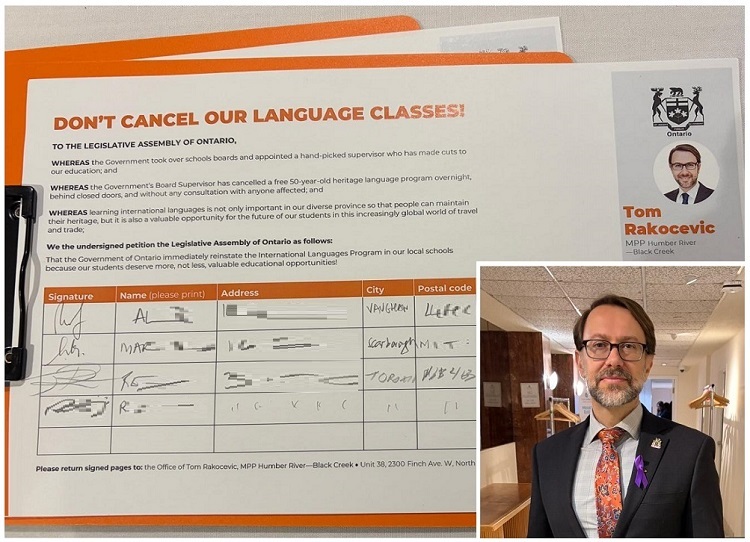
Opposition MPP Tom Rakocevic, made the case for the public: “I don’t se the sense in cutting this program nor the alleged savings to be garnered from eliminating it for the children and parents who are beneficiaries”. When asked how many students are affected, he said, “I can tell you there are 44 schools in this Board that offer ILP, nine (9) in my constituency that do it on a daytime basis for twenty minutes – for those registered.”
From a pedagogical and sociological perspective, if no other, this validates the learning of their parents and grandparents. It seems a drastic cut with no appreciable benefits. Teachers are required by law to be in their classrooms at least 15 minutes before the first class and 15 minutes after the last, at any rate.
Could no Superintendent, CEO, CFO of other senior Staff member come up with an alternative? The suggestion that schools may remain open on weekends for ILP registrants willing to pay $650 for the privilege is offensive and reeks of residual discrimination. From a Catholic school board this is especially galling.
In the photo, the petition organized by Tom Rakocevic (the signatures and addresses have been deliberately made illegible by our editorial staff, to protect the privacy of the signatories) and the MPP