The Constitution is not an “À La Carte Menu”

TORONTO – Canada, governed by whim or constitutional practice?
Let’s ask Quebec. The Constitution of 1982 (a remake of the British North America Act, 1867) defined our agreed-upon rights as residents of Canada, taking due consideration for geographic, religious, linguistic, provincial/regional differences and the legal bases for the peculiarities of Law peculiar to the organization of a country as vast as Europe.
The Courts everywhere in Canada have been consistent in reaffirming that, political persuasion aside, political exponents must swear allegiance to the monarch in order “to sit” in [any] legislative council. Any laws passed by legislators who had not sworn the oath would be unconstitutional, according to learned jurists, including Provincial Statutes, which are not at the same level as the legislative authority recognized by the [Federal] Constitution Act.
This subtle distinction for some, came about because the Quebec Legislature passed legislation in 2022 amending the Constitution Act to exempt Quebec Members of the National Assembly – provincial members of the legislature – from that obligation. Perhaps convinced that “activists”, sovereigntists et al., in the Legislature had overstepped their authority, some defenders of Constitutional rights appealed to the Superior Court in the province, among other serious “thinkers”.
Many others sought reprieve from [sic.] repressive colonialism or justification for their anti-monarchy views in the expressions of newly elected premier St-Pierre Plamondon who continues to maintain that Quebecers never consented to the Constitution. More egregiously, he maintains – I paraphrase – the Legislature owes allegiance only to the people of Quebec.
No matter how nationaliste MNAs might view themselves, Quebec still shares partnership in a Canada where a common [equal] citizenship binds fellow citizens in rights and obligations.
On November 23, Chief Justice Demers agreed: “The Constitution is not an à la carte menu where a subject complies with whatever suits them,” he wrote.
Unless, that activity is specifically permitted in the Constitution Act. At a municipal/civic level, the “legislative authority” must also include the swearing of fealty to the magisterium of the school system (under sec.93, for example, the Catholic Church). Nothing in Section 93 compels non-Catholics to abide by the strictures of denominational rights – there is an equivalent, some say superior – system at available to them, at no cost.
Yet, in last week’s ceremonial swearing in of the elected school trustees to their fiduciary duties, a dangerous new approach to qualifications for public office was noted: scant adherence to qualifications based on residence, citizenship and religious affiliation. These scofflaw trustees should never have been allowed to present themselves as custodians of our children.
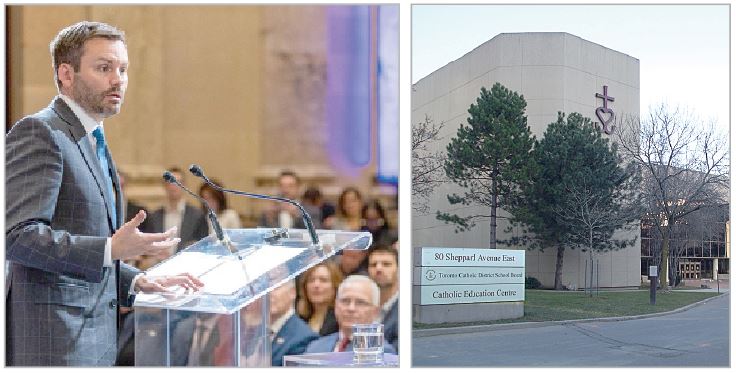
In the pics below, from left: Québec Premier Paul St-Pierre Plamondon (photo: Twitter X – @PaulPlamondon)
and the Toronto Catholic District School Board (photo: Jess O – Wikipedia)