De Francesco’s “Cure” Becomes a Lucid Nightmare
TORONTO – Italian filmmaker Daniela De Francesco is about to release her feature debut Dreamcatchers, which is being marketed rather tritely as a “sleep-disorder thriller”. But the filmmaker would certainly have had a mountain to climb in the research/development phase of the project. Even thousands of years after Hippocrates (the Father of Medicine) separated medicine from superstition and magic, there remains no scientific consensus as to why humans experience dreaming.
Dreamcatchers’ plot follows a young doctor starting his PhD at a prestigious sleep clinic. The “thriller” component involves the clinic’s high-risk experimental trial known as “The Cure”, a treatment which places the patient into an intense lucid dream state.
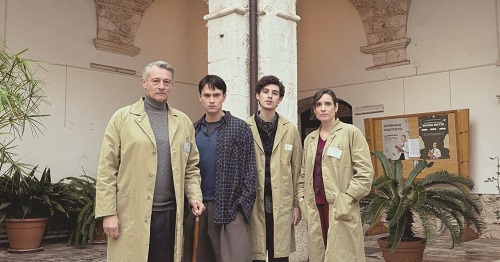
Filippo Scotti, known for his role in Sorrentino’s semi-autobiographical The Hand of God, plays the young doctor. The patient being lulled into lucidity is Saul Nanni, hot off his role as the young and ambitious Tancredi Falconeri in the Neflix remake of The Leopard.
Complications ensue when the boundaries between the patient’s dreamworld and waking life begin to blur, which leads to a “shocking murder”. Far-fetched as the movie’s synopsis may read, the intense and visceral experience of lucid dreaming is actually being studied by neuroscientists.
By attaching electrodes to a patient’s head a face, scientists have monitored the prefrontal cortex both during a “normal” and lucid dream. During the normal dream state the area responsible for logic and self-awareness is largely dormant. But there’s a partial waking in this region during a lucid dream – creating a “hybrid state” of consciousness. That is, the line between dream reality and waking reality becomes somewhat skewed.
Even historically, as far back as the Greeks and Romans, people accepted the connection between worlds. Some even volunteered to be monitored while they sleep. Known as “incubation” (from the Latin “incubatio”), people would sleep in a temple dormitory called an “abaton”, and were watched over by Temple Priests who administered cathartic rituals and psychic surgeries.
The idea was to invoke dream symbols or visitations from deities during the sleep state, who could prescribe treatments, herbal remedies or diets for whatever ailment they were enduring. Upon waking, the Temple Priests would attempt to interpret the vision. In essence, a dream Doctor.
Similarly, Catholics might refer to the Saints Cosmas and Damian who were in essence the first “Doctors without borders” – or as they were called, the “unmercenaries” who practiced medicine without charge.
After their martyrdom, an official veneration of the twin brothers included temple sleep healing in their name, expecting to be visited by them in dreams. Documented miracles have been attributed to them, most famously the “Miracle of the Black Leg”, in which they repaired a Roman verger’s gangrenous leg in his sleep.
Yet De Francesco’s exploration of sleep was motivated by more than history or science: “In this film, we wanted to explore the tension between the clinical desire for scientific control and the unpredictable nature of what happens when those boundaries collapse”.
Image of the Cast courtesy of The Piranesi Experience and Andromeda Film
Massimo Volpe is a filmmaker and freelance writer from Toronto: he writes reviews of Italian films/content on Netflix