A Forgotten Italian Olympian Immortalized on Film
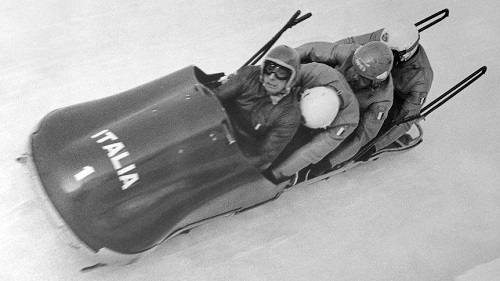
TORONTO – Perhaps more than any other sporting event, the Winter Olympics highlights the human story above athletics – which is nowhere more evident than with the bobsled competition. Take the 1988 four-man Jamaican bobsled team in Calgary, for instance. Though they were disqualified, the team was immortalized on screen largely because they were a tropical nation competing in a niche winter sport. And now, an Italian bobsled success story is finally getting its own movie.
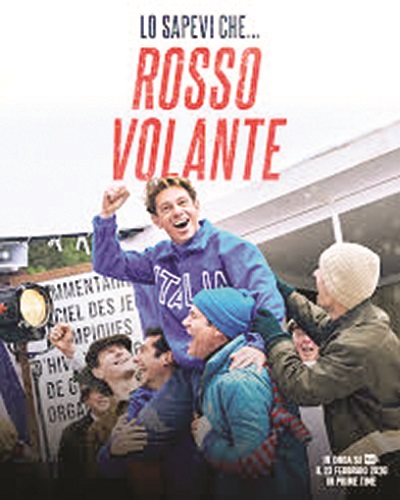
In fact, the current venue for the bobsled, luge and skeleton track in Cortina is named after the film’s subject – Eugenio Monti. Titled Flying Red, after Monti’s nickname for being a speedy Alpine Skier with red hair, Rai 1 will air the film on Monday February 23rd as the curtain falls on Milano/Cortina Winter Games.
After tearing ligaments in both his knees from an accident, Monti turned from skiing to bobsledding, where he won nine World Championship titles and six Olympic medals. He even became the first man to win both the two and four-man bobsled events at the same Winter Olympics.
Considering the Jamaican team received the Hollywood treatment after winning nothing, Monti’s success should be enough to justify the commemorative film. But as was the case with Cool Runnings (1993) the real story with Flying Red is about the man. Beyond his credentials, Eugenio Monti is best known for his incredible sportsmanship.
While chasing a gold Olympic medal in the two-man bobsled in 1964, the only accolade missing in his trophy case at the time, Monti won the hearts of audiences worldwide. While in the running for the gold, Monti handed his British rivals Tony Nash and Robin Dixon his spare bolt after their sled came apart.
The British pair were about to withdraw due to the malfunction, but Monti kept them in the competition with the sporting gesture. Consequently, Nash and Dixon went on to win the gold medal posting the fastest time in the final run. Though Monti would finish in third, his grace shone in the aftermath when he was asked about the irony: “Nash didn’t win because I gave him the bolt. He won because he was the fastest”.
The gesture earned him the first ever Pierre de Coubertin Medal for fair play. Monti would finally claim gold in the 1968 Grenoble Winter Games, in both the two and four-man events. Screenwriter Giorgio Pasotti described the weight of Monti’s achievements in Italy and in the Olympic community.
“The Cortina Olympics were the perfect opportunity to tell the story of Eugenio Monti, his life and his example, which is now being lost.
The Olympics highlight those sports that no one talks about for four years, and showcase the exploits of athletes who spend their lives chasing a medal”.
Sadly, Monti’s life ended in tragedy as he attempted to take his own life while suffering from Parkinson’s Disease. The Olympic Hero later died in the hospital in 2003, but the memory of his noble spirit is now immortalized through art – in Flying Red.
Images courtesy of Rai 1

Massimo Volpe is a filmmaker and freelance writer from Toronto: he writes reviews of Italian films/content on Netflix